From Village Green to Shared Playing Field
From village green to shared playing field, learn how clear entrances, signs, paths, and activity zones help neighbors understand access and share open ground.
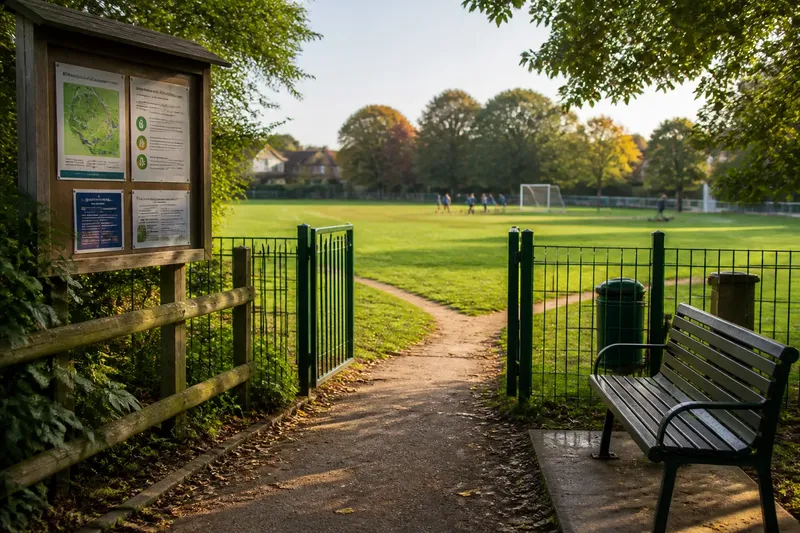
From village green to shared playing field, the question is simple: who can use the ground, and how can they tell? The answer depends on the particular place, its local arrangements, and the signs it gives a first-time visitor.
A worn path, a gate, a noticeboard, or a line of trees can shape whether someone feels welcome to enter or thinks they should keep moving. These details matter even when the grass itself looks open to everyone.
Local history shapes how shared ground is used
In some communities, open greens have long served several purposes, such as providing a route across a settlement, a gathering place, or ground for recreation. The mix of uses and the customs around access vary by location, so it is safer not to assume that every green followed the same history or rules.
Shared use does not necessarily mean unrestricted access. Local rights, management, and customary expectations can differ, and regular users may know unwritten patterns that newcomers cannot easily read. A visitor who does not know when a gathering takes place or which area is being used for an activity may feel out of place even when entry is allowed.
Some open spaces have been adapted for more organized recreation, while others continue to accommodate a variety of everyday uses. A marked field can make activity easier to locate, but boundaries also raise practical questions: who maintains the space, how are bookings communicated, and is there room for informal use?
A shared playing field makes its arrangements visible
Gates, painted lines, goalposts, benches, booking boards, and signs all communicate how a playing field is meant to work. They can help different groups share it, but they may also make casual visitors wonder whether the space is only for people who already know the routine.
A low, open entrance and a locked gate with a booking notice send different signals. The first may suggest that people can walk through or pause nearby; the second suggests that access depends on permission or a schedule. Neither is automatically wrong. The useful question is whether the boundary has a clear purpose and whether visitors can understand what access remains available.
Seating also affects who can stay. A bench facing the field gives spectators and caregivers somewhere to rest; a bare perimeter may leave them standing or out of the way. Small design choices influence whether a field works only as a place to play or also as a neighborhood space.
Clear information can reduce confusion about shared use
People may call a field shared because several groups use it, because the public can enter, or because no single group seems to control it. Those meanings do not always match. A casual visitor may assume the space is open while a club expects exclusive use during a booking; a resident may expect a walking route to remain clear during an event.
A noticeboard can explain recurring bookings and public access in plain language. A map can show entrances, paths, activity areas, and temporary closures. Clear information will not resolve every disagreement, but it gives visitors a common point of reference instead of leaving them to guess.
Say a neighborhood field has a youth activity scheduled in the early evening, and residents also use a path along its edge. If cones block that path, walkers may think the entire field is closed. A sign marking the activity area and directing people to an open route could clarify the arrangement; if no safe route remains, the site manager may need to explain the temporary closure instead.
Boundaries should explain both limits and alternatives
Fences and signs may protect a surface, separate people from active play, or manage a scheduled event. A boundary that is hard to find or understand can make a place feel closed even when some public access is intended. Visitors need to know why a limit exists and what they can do instead.
Approach the field as a first-time visitor. Can you spot the entrance from the street? Is it clear whether walking across the grass is allowed? Is there a place to watch without standing in the path of play? These questions reveal whether access depends on local knowledge.
A playing field is a little like a kitchen table: it can host dinner, a craft project, or a stack of mail, but people need to see what is already in use and which parts are available. A marked activity area, an open route, and a place to sit can make different uses easier to understand without pretending that everything can happen everywhere at once.
Check the field from a visitor’s point of view
A brief walk around the approaches can turn a vague concern about welcome into a specific decision. Note what you can observe, then choose an action that fits the result rather than assuming every barrier has the same cause.
- Check whether an entrance is visible from the street; if it is easy to find, keep it clear, but if it is obscured, ask the site manager whether a sign or path clearance is appropriate.
- Check whether signs explain public access and booking times; if the wording is clear, follow it, but if it is missing or ambiguous, ask the manager to clarify the permitted use.
- Check whether a walking route remains open during activity; if it is separate from play, use it, but if it is blocked, look for a posted alternative or contact the manager before crossing an active area.
- Check whether activity boundaries are visible; if cones or lines clearly mark the area, stay outside it, but if the boundary is unclear, wait for direction or ask an organizer rather than guessing.
- Check whether a place to sit is available away from play; if a bench is safely positioned, use it, but if there is no suitable seating, avoid standing in a playing or walking route and raise the access concern with the site manager.
- Check whether a notice identifies who manages the field; if a contact is listed, send that person the specific question, but if none is shown, ask the local council or parks department who handles access information.
Maintenance can affect who feels welcome
A clear path, usable seating, a litter bin, and an entrance not hidden by overgrowth can suggest that visitors are expected. Neglect can send the opposite message, even if public access is technically allowed.
Maintenance choices also shape whose needs receive attention. A surface kept ready for one organized activity may leave little space for informal movement. A field with nowhere dry to sit may be harder for an older neighbor or a caregiver with a child to use. Calling out a specific barrier is more useful than treating “open to everyone” as proof that everyone can comfortably participate.
Community groups can invite comments from players, walkers, nearby residents, families, and people who prefer to watch. The goal is not to satisfy every preference; it is to distinguish accidental barriers from deliberate trade-offs that deserve a clear explanation.
What should visitors know before using a shared field?
Can anyone enter a village green?
Access depends on local arrangements; the word “green” alone does not settle what visitors may do. Read posted signs or ask the local council or site manager if permitted uses are unclear.
How does a village green differ from a playing field?
A village green may accommodate a variety of community uses, while a playing field is more likely to be arranged for recreation. The distinction varies by place, so look at the layout and access information rather than relying on the label alone.
How can organized groups and casual visitors share a field?
Visible schedules, distinct activity areas, and an open route can help people understand where they may play, walk, wait, or watch. If the schedule and boundaries are unclear, ask the site manager or organizer before entering an active area.
Who can clarify uncertain access?
Start with the site manager, local council, parks department, or community organization named on a noticeboard. Describe the exact issue, such as a blocked entrance or unclear booking, so the response can address the barrier.
Access depends on more than an open gate
The shift from village green to shared playing field is not simply a move from informal space to organized sport. It reflects an ongoing negotiation between public access and particular uses. A gate may stand open while visitors still feel unwelcome if they cannot tell where to go or whether they belong.
Look first at entrances, paths, signs, seating, and the boundaries around scheduled activity. For anyone searching from village green to shared playing field, those visible details offer a practical way to judge whether expectations are understandable and whether people can take part or simply spend time there.
Not everyone arrives ready to play. Some neighbors come to watch, cross the grass, or grow familiar with the space before joining in. A field that makes room for those quieter forms of use gives people a clearer way to belong without asking them to take part in the same way.